When I logged onto Facebook this morning, I saw lots of friends posts on their New Year's resolutions, plans and summaries of their NYE festivities. Well, I didn't have a very "exciting" NYE (spent it at home watching a movie), but I guess you could say I have some New Year's resolutions. Although it's not really because of the New Year; all that happens between Dec 31st and Jan 1st is you put up your new calendar. It's not like there is anything specific about this day that makes it easier to keep promises to yourself. However, this seems to be the time when people like to state their short term future goals and planned changes, so I will do the same.
Cut out Soda
Eat better
Sleep enough
Train smart
Recover well
As you may notice, most of these are lifestyle goals, not sport specific goals. Of course I have race goals, season goals and workout goals, but those are secondary to these. Why? Because I don't want to make the mistake that many athletes do, and that is mentally separating their sport and training from their lifestyle. Having coached high school sports I have seen example after example of this mistake being made. "I work hard at practice, why am I not getting better?" (because your diet consists exclusively of soda and pastries, you average 4 hours of sleep per night, you go directly to other activities without eating, you made snow angels in your speedo and got sick... the list goes on).
If you watched the Olympic Games in Beijing, you may remember Ryan Lochte was famous for eating at the McDonalds in the athlete village every day (every meal most days). Now he's an amazing swimmer and obviously had success. However, since that time it is apparent that he was shooting himself in the foot. His diet has supposedly changed, and I'm inclined to believe it because in many of the National and World Championships since the Beijing games he has been establishing himself as the swimmer to beat, not Phelps. Many of his times have been as good or better than Phelps' times in Beijing. Now I'm not trying to bash anyone here, all I'm saying is that how you live your life outside of your actual time racing and training will affect how well you do those things. It's not my opinion, it's physiology. My opinion is that it is up to each athlete to make sure that their goals align with their lifestyle, or make sure that your lifestyle aligns with their goals.
Put another way, if you're trying to squeeze every ounce of athletic performance out of your body, there is no room for poor nutrition, poor sleep habits or any other activity which jeopardizes that. Not to say that you can NEVER have a sugary snack, but you need consistent good habits. However, there are a lot of sacrifices that can come along with elite athleticism; I don't think you'll ever hear an elite athlete say that he or she hasn't made sacrifices to get to that level. And whether those sacrifices are worth it is up to the individual athlete.
Getting back to my "resolutions"... it's not that these are brand new. I'm not flipping a switch on Jan 1, 2012 and making extreme changes. In fact, the entire past year has been an exercise in working to improve in these areas, and I have definitely been making progress. However there is more progress to be made and I am at the point where those gains are going to be very difficult to make without some other changes. One thing that is beginning on Jan. 1st is a change in my duties, responsibilities and hours at work that will be both in my benefit and that of Endurance House.
I also have a stronger motivation for this season than I ever have before. Unfortunately, the reason for this is very sad. Recently, one of my best lifelong friends was killed in an automobile crash. We grew up together and were best friends in childhood. He was my best training partner for years of swimming and track as a high school athlete, and got me started in triathlon. He was also one of the best athletes I've ever known who could motivate me with his accomplishments or just by running together. Since high school, he was always very supportive of my athletic endeavors in triathlon. While it's tough to come to terms with what happened, one way I intend to honor his memory is to train and compete in his honor.

Sunday, January 1, 2012

Wednesday, November 23, 2011
Time Off
Every athlete needs some time off every now and then, just not every athlete knows it. The word "recovery" has been thrown around a lot in the last few years in triathlon and sports circles. So what does that mean? I think some athletes take it too far (including myself at times), while others neglect it completely (including myself at times). I'm not going to spill all of my thoughts about recovery, time off and their effect on training now, because that is not really what this post is about. I just want those triathletes out there reading this to think about what they are doing during their off season to best prepare for 2012. Are you sitting on the couch, eating pizza and playing Mario Kart for 8 hours a day (ah yes, I remember fall 2008)? Did you start training the day after your last race this year? Or maybe something in between? During the off-season, ask yourself why you are doing what you're doing, and how that is preparing you for next season. If you can find a good answer to that question, you're on the right track.

Yoshi is totally the best character in Mario Kart
It's also been quite some time since my last post here. It's not that I haven't wanted to write. It's not that I haven't had anything to write about. And it's definitely not because I wasn't happy with my final races: 1) I was. 2) I'm not afraid to write about a disappointing performance, just as I'm not afraid to put myself in a race where I'm the underdog. So if anyone has been compulsively checking my blog for updates on a daily basis J, I'm sorry to have kept you waiting. I've been very busy with other things going on... training, racing up until October, working, and figuring out how I'm going to structure things for this coming year. There's really been a lot of news over the last few months, so I will try to get it all up here, although it may span a couple of posts.
I think the best place to start is where I left off, with my final races of the 2011 season. After Lifetime Fitness, I had three left on the calendar, and they were all important, travel races:
Age Group Nationals- Late August
Age Group Worlds- Early September
Branson 70.3- Mid September
From a training perspective, the challenge was to get myself ready to race well at all three of these races, despite the fact that they are too close to peak for individually, yet too far apart to peak 100% for all 3. It was decided that the training peak would be planned for the Worlds/Branson combo, since they were only a week apart, and Nationals would have a smaller recovery leading into it. From an organizational perspective, the challenge would be just as much if not more. The races were in Burlington, VT, Beijing, CN, and Branson, MO. The Beijing to Branson week was going to be key to get right, since I would be trying to fend off major jetlag in addition to all of the travel stress.
Nationals:
This race went well, but not very well. I felt really good in the water for the first time in a while, but then proceeded to follow a group off course. I realized it before the rest of my group, but unfortunately I probably swam 200 meters out of my way. It's really hard to put that mistake out of your mind as you are trying to focus on the bike and run, but I did a pretty good job of it. I definitely was able to focus more in the moment than the other race this year with a major swim mishap (Texas 70.3 and the goggle disaster).
On the bike I felt strong and was riding well. I ended up probably not riding hard enough, as I felt a little too good coming off the bike. My run was solid that day, but I started to fade as the temps rose. I ended up finishing well enough to re-qualify for Age Group Worlds with a roll-down spot. However, for the first time that I’ve qualified, I won’t be going. More on why later.
Worlds:
This was my third time at Worlds, and each time has been a unique experience. I enjoy testing myself against great competition, meeting triathletes from other states and countries, and also traveling to new places. Beijing did not disappoint. I was looking forward to this trip even more than my previous Worlds for a few reasons. First, while Germany and Australia were great locations, China was going to be completely unlike anywhere else, and, unlike the first two, I’m unlikely to ever go back if not for a future race. There’s so much history there, and a completely different culture than what I’m used to. As far as the race itself, in Germany I was ecstatic just to have squeaked into the race. In Australia I showed some promise but couldn’t put together a complete race under pressure. Going in, I was confident in my abilities and felt I was ready to put together a great race on a big stage. Did I think I could win? Unlikely, but I was ready to compete with the top group of guys.

The Great Wall was my favorite sightseeing destination
Racing on the 2008 Olympic course was incredible. It was quite a rush.
And then I crashed.
It was pretty surprising. I realized I was going to hit the fence a few seconds before I did, but I was expecting to fall sideways into it. I didn’t expect to flip over the handlebars and land on my back on the road. At 25mph.
It could’ve been worse. I saw another guy later who did pretty much the same thing as me in about 5 different casts and wraps with cuts everywhere. And we were in China. So I was counting my blessings that I came out of it with only a small cut on my forehead and a scraped and sore left shoulder. The first two thoughts in my head as I hit the ground were “Holy shit, that just happened!” followed immediately by “I need to get off the road before someone runs me over!” So I stood up, grabbed my bike and walked over to the side as riders screamed down the hill by me.
A race doctor ran over to me (“Great, so they expected crashes here…”) and asked me if I was ok, pointing at my head with a weird look on his face. “Yeah…” Then I took off my sunglasses and used them as a mirror and sure enough, there was a stream of blood running down my face from my forehead. I felt fine, but wanted to make sure I didn’t have a concussion, so I sat there for a few minutes just thinking about stuff. I seemed to be fine, so I wiped the blood off, the doctor rubbed some iodine on it and covered it with a band-aid, and then I looked down at my bike. It had landed upside down so the saddle and handlebars were bent in odd positions, but that was fixable. A few minutes later I got back on the bike and took off, to many cheers.
From then on I was riding like a total wuss, braking on all the downhills and corners, just thinking that my main goal was to get to the finish line intact. After an uncomfortable, slow ride I got off and actually ran pretty well, despite an increasingly sore hip. I felt proud of myself for fighting through everything and getting to the finish line. I wouldn’t have been happy just to jog in, though. If I was going to do that I’d rather throw in the towel after the crash. I pushed hard to the end, competing the best I could along the way. For the first time in 5 years, I was actually proud of myself for finishing a race.

Crash aftermath
Branson 70.3:
This race was all about overcoming obstacles. I’ve read about that before. Every time Ironman comes around you read articles about someone who overcame something just to get to the starting line, or who dropped 100lbs training for the event or something similar. You hear a lot of these people say that the event means so much more to them because of what they overcame to start or finish it. Well, I’ve never really felt like I’ve overcome anything too significant before or during a race. I used to be much slower and less skilled, and have steadily gotten stronger and faster, but there has really been nothing specific until this fall.
First there were the expected obstacles. Jetlag, travel and post-race soreness from Worlds. I admit that signing up for Branson only one week later was not ideal for racing well, but I did it because I figured most of my competition would be thinking that as well. The thing is, I selected Branson because of when it fell on the calendar. ITU Worlds was the week before, 70.3 Worlds was the week before, Hy-Vee US Championships was 2 weeks before and Kona was only a couple weeks later. My thought was that anyone who was racing any of those events wouldn’t want to do Branson.
Not that I shy away from competition, but when you’re trying to meet qualifications it’s important to choose your races to give you the best chance of success. I knew there would still be good athletes there, just less depth in the field. And I was right. I had looked at the 2010 athlete guide and saw that last year the prize purse was large enough to make it a pro qualifying race. Prior to Worlds, I thought that despite racing in China a week before, I could recover and race well enough to qualify. I did a great job timing when I would sleep on the plane so that jetlag was minimal when I got back.
I didn’t expect not to be able to swim after Worlds, though. My shoulder got worse and worse for a few days and it wasn’t until Friday that I could even swim down the pool. I was sweating it, the race was in two days and my shoulder was still really sore.
Then on my drive down I got the news that came closest to breaking me. The new athlete guide had just come out (yes, only days before the race) and the prize purse had changed. It didn’t change in a good way, and now the race was no longer an elite qualifier. I was doing this for nothing. “What’s the point? I’m tired, sore and slightly injured. I don’t need to prove I can finish this thing. Even if I win it doesn’t matter, I can’t use it for anything. I’ve raced a lot and have had a long season. The weather is horrible, it’s not worth it” These are the thoughts that went through my head upon hearing this news.
It would’ve been really easy to just go through the motions, or even easier to just turn around and drive back to Madison. Luckily, I had a great support crew who talked some sense into me. My girlfriend had decided to come with me down to Branson and while she was disappointed too, she encouraged me to give it my best shot. After all, it’s not worth doing something if you’re not going to give it your best, and we were already here. I’ve come this far, it’s time to finish what I started.
And so that’s the mindset I went into the race with. While it didn’t have any future implications, this was a race and just like any race, an important one. I’m a triathlete, I signed up for this race, I'm here, so I should just do it. It doesn’t matter what I’ve done in the past, or what the future holds. When the gun goes off, the only thing that matters is the task at hand. It's an opportunity to hone my skills and gain experience.
I’m not sure how, but I was able to swim the entire way. My shoulder felt 90% and I biked well. If it weren’t for my electrolytes flying off my bike halfway through, this may well have been the breakout race I’ve been looking for. While things went downhill from there, I managed to hold it together well enough for a 5th overall finish. While the depth of the field wasn’t as strong as some races, I am very happy with that result and even more so because of what I had to overcome to do it.
As a side note, my sister wrote a great article about the China trip, which USAT actually put in their newsletter and posted on the front page of their website:
Monday, July 11, 2011
Lifetime Fitness
7/9/11- Minneapolis, MN
The race started from the beach with all the elite amateur athletes charging into the water. Since I am more comfortable breathing on my left I positioned myself near the outside right of the group with a straight path to the first turn buoy. The first 200m went by quickly and I was feeling good. I noticed that the main pack was veering way to the left, so much so that I spotted a few extra times just to make sure that it was them and not me drifting. Lucky start, I thought. "Seems everyone else wants to swim further... fine by me." The water was a balmy 82 degrees and thus we were not wearing wetsuits. This was something else I figured would be advantageous.
After feeling strong for the first section of the course, I rounded the turn buoy and that's when I met Mr. "I'm a horrible drafter". The rest of the swim was the most annoying 15 minutes of my life. He was swimming on my right side with his head about 6 inches from my hips and was literally running his left arm into my ribcage every single stroke. That made it really hard to hold my body position, not to mention at this point my stroke wasn't feeling good anymore. Because I was not going to swim off course I had to put up with this guy ramming into me the whole back stretch. After the second corner I was really getting sick of this so I tried to sprint a little. At first I thought I lost him but then he started tapping my toes every single pull. I veered right, he followed. Veered left, same. I didn't want to red-line the last 500m of the swim so I settled back into my pace and again he was on my side. I somehow lost him in the final 50 meters so I didn't have a good chance to punch him in the face when we got out of the water. Oh well that probably wouldn't have worked to my advantage in the grand scheme of things...
Coming out of the water, my mom, who travelled up to watch the race (Thanks!) told me I was in 9th. That got my spirits up, since even though my swim felt slow (and it was but so was everyone's) I remembered that last year I got out of the water in 11th at this race. So I hopped on the bike excited to put the swim behind me and hammer the bike.
Getting on the bike I passed a few guys in the first miles, but soon found myself struggling to find the power that came easily just 2 weeks ago in my workouts. I don't race with my power meter and I'm glad I don't know what my average was because I don't think I would be very proud of it. The bike course was technical, which didn't bother me, and it was on poor quality roads, which at least I was ready for and set my tires to 110psi instead of 120 like normal. As the ride went on it became more of a struggle... there wasn't any specific part of me that really hurt, and my breathing wasn't out of control, but I just felt achy all over and was having trouble finding strength. I came off the bike with a split of 1:04, which is my slowest 40k in awhile. Last year was a 1:01 on the same course.
Again, going into the run I thought if I could find my form that I could have a good run split that would get me back near the place I thought I could be. It was a flat, fast run course so a 36 should've been doable, and in the back of my mind I knew I could run a 35 on a great day. However, it soon became apparent that it just wasn't my day when my turnover and stride length just weren't there. I ran a low 39 and finished with a 2:09. I gutted it out the best I could but there was no snap in my legs this weekend.
Initially I was pretty disappointed, but not because my time was bad... a 2:09 is a good time. I was bummed because I had been biking and running much better during workouts a couple weeks ago than I did on race day. After going back to the house I was staying at for the weekend (Thanks Dave!), passing out for a few hours and then hanging out at the Mall of America for the rest of the day, I had plenty of time to reflect on the day and the season so far.
This race had been high on my priority list for this season since it started. I knew the course well and was in the middle of my season. I was fit and motivated going into it and thought that this might be the time when I break through to the next level. I track my workouts and the trends were all there. I don't think I did anything wrong on race day or race weekend. Actually my race plan was executed very well. I think, and more so after talking with Blake Becker, that I pushed my workouts too hard recently. I, like many athletes, am very motivated to train hard and sometimes I can overdo it. It's tough because the days you feel the best are sometimes the days you need to hold yourself back the most in training. After a long season, which this has been (I started training in earnest back in January) you need to make sure you are giving your body adequate recovery time. Blake tells me this a lot, and I know it too, but it's always easier said than done.
While I wish every race I do would be one of my best efforts, that will not always be the case. The really important things for long term success are how you progress in your training, the consistency and adequate recovery time. Basically it is a lifestyle. Lifetime Fitness. I haven't gotten to where I am by training hard during workouts and then having an unhealthy lifestyle outside of training. My good overall health is a huge part of my continual improvement in this sport. To reach your true potential you have to live it. That does NOT mean that triathlon or sport should be the only thing in your life. I would consider that unhealthy and many athletes who take that path don't last long. Some do but sacrifice so much outside of sport to do it.
As I was lining up on the start line, they introduced the woman who would be the honorary race starter. She was 93 years old, and at the age of 89 completed this triathlon. Very inspirational.
I didn't perform my best on Saturday, but I am not worried at all because I know that once I rest up I will be back stronger than I have ever been. I know this because I have seen myself improve this year in key workouts across the board and have had some of my best races ever. I also know this because it is a lifestyle, and will continue to be. I don't know if I'll be able to do a triathlon at age 89 but I certainly intend to have lifetime fitness.
Monday, July 4, 2011
The calm before the storm
It's been some time since my last post here. Unfortunately I haven't had too much time to sit down and write over the last month. There has been a lot going on, just not too many race results to report. My biggest focus over the past couple months has been preparing for the second half of my season, which begins in just under a week at Lifetime Fitness, and continues through September with Nationals and Worlds.
So what have I been up to since St A's? Here are the highlights...
1.) I'm famous! For the first time that I'm aware of I was featured on another triathlete's blog! Actually, it wasn't me, but my car. And it had nothing to do with the car itself, but rather the 3.1 sticker on the back. Thanks to Jack Dudley for getting those custom made!
My car is awesome


Also, a quick note on bike safety:
Every year I hear of multiple bike accidents, some of them resulting in deaths. Most are in training, as in the case of the 2010 Collegiate Cycling National champion Carla Swart. Every so often it happens in a race, such as Wouter Weylandt in this year's Giro d'Italia. Over the past 7 years I've done this sport I've seen multiple friends, a roommate and my girlfriend wind up in the hospital after going out for a ride. Now that I work at Endurance House and have met or at least talked to the majority of triathletes in the Madison area, the likelihood of someone I know getting in a bike accident is much higher.
While some bike accidents involve only the rider, as in the case of Summer's broken hand (although that involved a squirrel too I guess) and my slide-out in my second year cycling, the majority of bike accidents involve vehicles. Unfortunately those are usually the most serious.
In my seven years of riding, I have never once been hit by a car or gotten myself in a situation where I would be forced off the road. I fully realize that some of this has to do with chance, and no matter how safe you are there is always a possibility that something could happen to you, but I do have a few rules I live by on the bike that keep me as safe as possible. I want to share them with you so that hopefully you can avoid any unfortunate situations...
1. Be serious and focus on the road and what you are doing. You are out there for a reason and that reason is not to goof around. Not saying don't have fun, but it only takes a lapse of focus for 1 second... make sure that even as you are enjoying yourself, you're staying aware of your surroundings and prioritizing safety over fun at all times.
2. Assume every automobile driver is distracted and/or an idiot. Of course this is not true, but it is not the majority of cars I worry about, it is the one or two distracted/stupid ones I will cross paths with over the course of any given ride.
3. Make eye contact with every driver stopped at an intersection that you think is waiting for you before continuing. It can be a costly mistake if you assume they see you and you are wrong (also, they might see you but not realize how fast you are going.. most people equate bikes with going slow).
4. When passing a line of parked cars on the side of the road, give at least 3 feet. I've heard bad stories of car doors opening...
5. Remember that it doesn't matter who is correct, vs a car you will always lose.
6. Put safety ahead of your workout. It won't kill you to stop and wait for a car to move out of the way during your intervals, and honestly it won't mess up your training either. I've seen some cyclists make some pretty high risk maneuvers just to keep their wattage above lactic threshold for that extra minute.
7. Please wear your helmet. Most cyclists and triathletes do wear them while training but I see some of those same people commuting around town without them. You're actually more likely to get into an accident commuting around town than on a training ride in the countryside.
So what have I been up to since St A's? Here are the highlights...
1.) I'm famous! For the first time that I'm aware of I was featured on another triathlete's blog! Actually, it wasn't me, but my car. And it had nothing to do with the car itself, but rather the 3.1 sticker on the back. Thanks to Jack Dudley for getting those custom made!
My car is awesome

The funny thing is that this photo was taken while my car was parked at the Triple T in Ohio over Memorial Day weekend. While I had originally signed up to do this race with my girlfriend as a team, I didn't actually end up going due to her breaking her hand. However I had some friends from out of town that were originally going to hitch a ride with us, so I lent them my car for the weekend. Definitely a good decision!
2.) The great June triathlon! This race was so epic that it took two whole weeks to get from start to finish. It began at the Lake Mills sprint triathlon early in the month. After a good swim and great T1, I hopped on the bike in 5th overall, excited to race some of the best local athletes in a very competitive Wisconsin season opener. However, it quickly became challenging the hold my pace. It felt like I was riding through mud. After pushing through it for a mile or so it kept getting worse so I stopped to check my tires... sure enough the rear one was flat. After getting sagged back to T2 I watched the 3 pro's and multiple All Americans in attendance finish the bike and run.
Two weeks later my triathlon resumed, when morning storms caused the cancellation of the swim at the Verona Triterium. We started the race on the bike and despite the wet descents and corners and a dropped chain late in the race, I came off the bike over a minute faster than I did in 2010. The run was less than stellar but I held on for 3rd overall.
3.) Madison Marathon pace team and Capitol View Triathlon! The MMPT was something new that I got to tackle this year. Endurance House was sponsoring the race, and I was put in charge of organizing the pace team. Even though I had never been a race pacer before it was a lot of fun. I split the 3hr marathon w/Justin Pernitz. I got us through the halfway point at 1:29:50 and then got back to the Capitol to watch Justin come in at 3:00:04. Perfection.
A couple weeks later, the 4th annual Capitol View Triathlon went off without a hitch. With as much as I race, it's fun to be on the other end of a triathlon once a year as the swim course coordinator.
4.) Coaching summer swimming! Actually this is something that I'm not doing for the first time in 3 years. Honestly, with as busy as I am I can't imagine trying to fit it in my schedule and don't know how I managed last summer with my full time job and training. Hopefully I can get to a meet or two in July, though. Don't want to miss out on all the fun...
Every year I hear of multiple bike accidents, some of them resulting in deaths. Most are in training, as in the case of the 2010 Collegiate Cycling National champion Carla Swart. Every so often it happens in a race, such as Wouter Weylandt in this year's Giro d'Italia. Over the past 7 years I've done this sport I've seen multiple friends, a roommate and my girlfriend wind up in the hospital after going out for a ride. Now that I work at Endurance House and have met or at least talked to the majority of triathletes in the Madison area, the likelihood of someone I know getting in a bike accident is much higher.
While some bike accidents involve only the rider, as in the case of Summer's broken hand (although that involved a squirrel too I guess) and my slide-out in my second year cycling, the majority of bike accidents involve vehicles. Unfortunately those are usually the most serious.
In my seven years of riding, I have never once been hit by a car or gotten myself in a situation where I would be forced off the road. I fully realize that some of this has to do with chance, and no matter how safe you are there is always a possibility that something could happen to you, but I do have a few rules I live by on the bike that keep me as safe as possible. I want to share them with you so that hopefully you can avoid any unfortunate situations...
1. Be serious and focus on the road and what you are doing. You are out there for a reason and that reason is not to goof around. Not saying don't have fun, but it only takes a lapse of focus for 1 second... make sure that even as you are enjoying yourself, you're staying aware of your surroundings and prioritizing safety over fun at all times.
2. Assume every automobile driver is distracted and/or an idiot. Of course this is not true, but it is not the majority of cars I worry about, it is the one or two distracted/stupid ones I will cross paths with over the course of any given ride.
3. Make eye contact with every driver stopped at an intersection that you think is waiting for you before continuing. It can be a costly mistake if you assume they see you and you are wrong (also, they might see you but not realize how fast you are going.. most people equate bikes with going slow).
4. When passing a line of parked cars on the side of the road, give at least 3 feet. I've heard bad stories of car doors opening...
5. Remember that it doesn't matter who is correct, vs a car you will always lose.
6. Put safety ahead of your workout. It won't kill you to stop and wait for a car to move out of the way during your intervals, and honestly it won't mess up your training either. I've seen some cyclists make some pretty high risk maneuvers just to keep their wattage above lactic threshold for that extra minute.
7. Please wear your helmet. Most cyclists and triathletes do wear them while training but I see some of those same people commuting around town without them. You're actually more likely to get into an accident commuting around town than on a training ride in the countryside.
Thursday, May 5, 2011
St A's
The Race:
St. Anthonys triathlon was the final race of my spring season. It was an "A" race, one where I try to peak. I've raced very well so far this year, and training has been going great. On top of that, I've traditionally tapered well so I was excited to see a breakout performance! I backed off on my workload the week leading up to the race, flew to Tampa and proceeded to have an average race....
Now don't get me wrong, it wasn't bad. Actually, by last year's standards it would've been a very strong performance. Just not up to par with what I was expecting and what I have shown so far in 2011. As a coach in a sport (swimming) where the final meets of the season are put on a pedestal compared to the rest of the season, I've seen some incredible tapers, and others that just seem to flop.
Here's a great post game explosion, but this guy actually won:
But that doesn't mean you shouldn't be upset, or try to figure out why the taper didn't work. In my experience with swimmers, 90% of failed tapers are due to having nothing to taper from. In other words, you have to put in the work during the season or training block in order to give yourself something to come back from. The coaches are often blamed for the athlete's lack of work ethic. Many athletes don't understand what hard work really means. But many do. And I do. And my coach does. So if it isn't that, then what is it? That last 10% really could be caused by anything. It could be just a bad day, it could be poor race execution, it could be a mental breakdown, it could be due to any number of other, unidentifiable factors.
At first I just chalked it up to a bad day... but it turns out I was sick, I just didn't know it until I landed in Milwaukee that night. Of course that would explain why every time I tried to shift into that extra gear I couldn't hold onto the effort for more than 5 minutes. It explains why I lost focus towards the end of the run and finished looking "defeated" according to one of my friends who spectated the event.
Sunday I raced a 1:58 in an olympic distance triathlon where the swim was shortened from a 1500m to a 1000m due to water conditions. At my swim pace, that's ~2:04-2:05 on a true course. Like I said... very good if this had been last year. It's just that I opened this season with a 2:00 and felt great doing it, then rested more for this one and felt worse.
When I think about it though, it's not surprising really. It seems like everyone I know and spend time with has been sick in the last few weeks. My girlfriend had pnemonia, my boss at work has been sick all winter, and almost all of the people I train with came down with something recently. So this race is going in the books and it's forward from here. Time to rest, recover, and then get back to it.
The future:
To plan your future training, I like to look at the past. Specifically, I asses myself and my performance in the past training and racing block. I think all athletes would benefit from doing a personal self-assessment.
*Based on zero scientific evidence, this is the system of how I asses myself, everything on a scale of 1-10
Early 2011 Self Assesment-
Overall Physical Training: 7.8 (an straight average of all the following categories)
-Swimming: 6
Training-wise, I feel I have done worse here than the other 2 in hitting my key workouts and getting through everything. If there is a time constraint due to outside commitments, swimming is the first to go. I've completed almost all my workouts here, just not all in their entirety. Lots of workouts got cut short this training block and I need to get the rest of my schedule under control in order to fix this. This would probably be a 7 if I could swim straight, but it seems that it is something I fixed last year that once again needs work in open water
-Cycling: 9
My cycling has made the largest improvement from last year. For years it was my weakness but so far it has actually been my strength in triathlon. I have been moving up the field from where I exit the water, which was unprecedented in prior years. Last year I tended to hold my position and before that I'd lose spots. I credit much of my cycling gains this year to using a power meter w/a coach who knows how to.
-Running: 9
Running has also been going really well. In open, non triathlon running, it's probably my strongest single sport at the moment. My legs feel stronger and my form is better than it has been in the past. There's always room for improvement, though.
-Running off the bike: 8
This gets its own category since it is almost a different sport. A lot of it has to do with how hard you bike, and a lot of it is training your body for the transition. I've done some bricks this year but have had to split a few of them into separate workouts, again due to time constraints. I have felt ok off the bike this year, but have felt better at times in the past. This is something I expect to improve throughout the season.
-Consistency: 8
I've hit most of my workouts this year, but there have been times when I've needed to skip or re-arrange things. Consistency is key to continual improvement so I need to address this immediately to keep up with my goals.
-Speedwork: 9
Probably the reason I have been running and cycling so well this year is because I have done a very good job at hitting the key sessions and workouts in these two sports. I've made a point to go into these sessions ready to go and have seen improvement during the season in the workouts, which has translated into success in racing. The only reason this isn't a 10 is because every so often I have underperformed in a swimming speed session. This is probably due to lack of swim fitness due to low volume.
-Volume: 6
It's much better for short course racers to have a 9 in speedwork and a 6 in volume than the other way around, but it's still important to put in the mileage/yardage. Again, due to time this score is low. I'm not saying that you should do as much volume as you can... actually that will make you slower but there is a certain amount you have to do, and I found myself cutting short some of the "aerobic" or "junk" mileage this season so far.
-Core/Strength: 8
I have a pretty strong core, which is essential for performance across 3 sports and staying injury free through training. Early on in the season I would've given myself a 9 here. I was doing TRX classes twice a week with Kari Woodall and I felt it was making a big difference. But as racing started I haven't been to a Trx class (I have been doing some at home but it's not the same). I have definitely retained much of what I gained so it paid off. It's just hard to find time to do those classes and also get all of my swim/bike/run training in.
Sleep: 7
This score is just the average amount of hours I got per night, but I think it corresponds well to the 1-10 scale in how it effects performance. Sleep is crucial and is overlooked often. The workouts create the stimulus, but they break you down and in order to build back up there must be adequate recovery.
Nutrition: 7
This number is the average of race day nutrition (9) and day to day nutrition (5). A great training plan can unravel on race day if you don't do a good job with your nutrition plan during the race, as I have showed in the past. I've done well with that this year but my day to day is awful. It's improving and is a primary focus of mine for the rest of the season.
Mental: 10
This is the one area where I believe I excel. The only reason I'm competing at the level that I am today is because of my attitude towards the sport, my analytical approach to training, my belief that anyone can improve (even if you were super slow in the past like I was when I started endurance sports) and a never-give-up approach.
Total Score (ave. of physical (x2), sleep, nutrition and mental): 7.9
So this isn't bad but could go up. It's also interesting that it is extremely close to the physical score (7.8). Here's a theory.... your physical score is directly affected by your scores in the other 3 categories, and as they rise or fall, so will your physical. It makes sense... You'll be able to hit your workouts better, and therefore make improvements if you are recovering well and are motivated.
Almost done
Athlete of the week: Gerard Hubbard
More like only athlete I've featured thus far.
Gerard and I first met a few years ago at the Purdue triathlon. I was injured and spectating. I think it might have been his first triathlon, or at least one of his first. He looked like a power lifter, 5'8" and over 200lbs of solid muscle. He finished the olympic distance that day in around 3 hours. 3 years later, we raced at Age Group Nationals last September, where he raced a 2:10ish, still ripped but closer to 150lbs. That raised my eyebrows and I started paying attention to what he was doing with his training. Based on the facebook news feed, I came to realize the total dedication he put into his training. His focus was 100%, he seemed to get up before 6am almost every day to train, and the one thing in particular I noticed was his dedication to his nutrition. Personally, I consider myself to have come further that almost anyone I know and compete with at the elite amateur level to get there. I have to say almost now because Gerard makes me look like a natural. (no offense) On Sunday we went head to head and I beat him. But only by 2 minutes. Just last September the difference was 6 minutes and 3 years ago it was 45 minutes. I guarantee he will continue to surprise and also has really inspired me to take a good look at my nutrition plan and fix it. Maybe I can have similar results...
Wednesday, April 13, 2011
A big week
There was a lot on my mind Saturday night as I tried to fall asleep the night before the Texas 70.3. It had been a busy and eventful week, that's for sure. What I consider one of my talents, though, is the ability to focus on the task at hand when it requires it. As I jumped into the Gulf of Mexico to move towards the swim start my mind was clear and I was calm. I was just waiting for the gun to go off to flip the switch.

"Two minutes!, wave 5", I heard the race starter say as I was treading water at the start line. Cap was on, wetsuit adjusted, goggles just had a bit of water trapped inside. Shake the goggles out, suction them back on.... wait, why did they just fall off my face? Uhhh.... oh #$%& they just broke! Cap off, get the strap off me, take a look. Plastic piece connecting the strap to the frame on the right side is cracked. No way to fix that. Oh I am screwed if I don't think of something. Can't swim in saltwater w/contacts for 1.2 miles. I'd have to lifeguard swim it... that would add at least 10 min. Ok, think of something now! Pull the right strap out of the connector in back... wow that just took a minute, the gun is about to go off. Ok, see if you can shove it through the frame where the plastic piece is supposed to go. Thank God that worked...quick knot. 10, 9, 8... put the googles back on, just one strap now, rest of it dangling in my mouth... 3, 2, 1 gun.
So I was thrown out of my zone before the race began. When newbies ask me for advice I tell them that 90% of the time, no matter how long you've been doing this, that something will happen that you didn't plan for or expect. The best athletes will adapt and adjust on the fly and roll with the punches while others let it bring them down. Experience, studying the sport and knowing how your equipment works is the best way to make yourself adaptable to different situations that arise.
Going into the race I knew I was fit and ready. Earlier in the week I had set a new personal record in the 5k run, my first time ever under 17 minutes, in an individual time trial. I had the confidence going in that my training has been working and I was ready to race well from a fitness standpoint. However, I was also quite tired from staying up later than usual for a few days as I built up Summer's new bike to be ready for the Collegiate National Championships, which was held the day before my race in Alabama. (she had a great bike split, by the way!) I had also very recently resigned as the head coach of the McFarland swim team, a team which I have had 3 great seasons with. It was tough to leave, and I will miss the team. However, it was the right decision... the stress of the season with my job was not good for me. This was still heavy on my mind as well. I rested the few days before the race and then Saturday got to follow the Nationals race online. I saw the team do very well (7th women's team, 13th overall) but noticed that almost all of them suffered pretty badly on the run. Why? It broke into the 90's with humidity in Alabama. They did great for a team from the north (1st overall team in the Midwest conference) but without the heat training as some teams had we couldn't run with them. My race wasn't going to be quite as hot (just low 80's) but it was humid and twice as long. That's a lot of time to fold. So in light of that my race plan was to hold back on the bike so that I made sure I showed up to the 13.1 mile run feeling good and well hydrated. If I ran to my potential I could make up a lot of time.
After a very crooked swim in which I probably added ~50m to the distance, I came out of the water in 28:40. I probably wasn't able to focus on my swimming as much as usual with my annoying goggles. But in the end a minute or 2 isn't the end of the race but 10+ would have been so I'm not upset with my swim performance. On the contrary I'm happy with myself for minimizing my time loss and my goggle fix.
On the bike we had 20 mph crosswinds the whole way. It was one big out and back along the seawall next to the ocean. On Thursday I had to make the decision to bring my rear disk/front 808 combo or my normal training wheels. Speed or stability? Confident in my bike handling skills and thinking it would be a waste to go all the way to TX not to go all in, I showed up with my wind sails. (If I ever get rich or really heavily sponsored to have multiple race wheel sets, the best choice of wheelset probably would have been something similar to 404's... aero and fast w/out the wind issues.)
Overall it wasn't too bad. There were only ~3 miles towards the end where we got right up on the ocean where I thought I was going to crash about 5 times. I was trying to relax my upper body but my shoulders were definitely worked harder than usual trying to keep me in a straight line. Halfway through the sun came out, and I felt a significant difference immediately. I rode a 2:22 (23.6mph, a 56mile PR), with a huge negative split (1:17-->1:05) due to the slight tailwind on the way back. The winds did keep riders from forming packs as easily, and I was only passed once in the 56 miles. During the bike ride I went from 6th to 2nd in my age group. Due to lots of fluids, calories and electrolytes on the bike I got to the run feeling relatively good and ready.

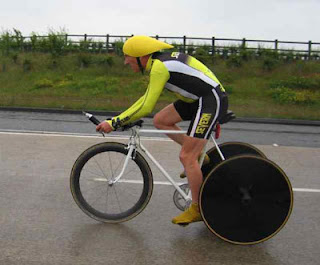
If I had been really worried, I could've just increased my stability by using two disks like this guy...
Coming out of T2 a guy in my age group I had just passed jumped out and I was tempted to follow, but due to the heat and my lack of acclimation to it, I let him go and reminded myself that I'll cut through the crowds at the halfway point if I can hold it together. It was a good decision, as 400m later he was already behind me. I honestly felt good on my first of 4 laps, and my average for the first 3.2 miles was 6:15/mile. On a better day I feel I could've held very close to that. However, despite my best efforts the fact is I just wasn't adapted to racing in hot and humid conditions and I started feeling it pretty badly at mile 4. I did manage to keep it from spiraling out of control and held a steady 7:10 average the rest of the way in. It was incredibly difficult and I felt absolutely awful as I finished, but I am very happy with my 4:25 for 3rd in the age group and 15th overall amateur in a field of ~2000.
It wasn't quite a PR (4:23) but that was set in better conditions and in the month of July. For a half Ironman at this time of year I am thrilled with the results. Yes I had in the back of my mind that a 4:16 was the elite qualifying time last year at this race and I think I am capable of that under better conditions, but I feel I raced tactically smart and very strong. Turns out that it took a 4:10 this year to go top 3 amateur. I did everything in my control to have a good race and that's all you can do. Besides a cool trophy and a pretty bad sunburn, I took back lessons that will help me (and hopefully others that read this) to do even better in future races.
Now that I'm back, it's time to get a half Ironman tattoo, like this guy....
Monday, March 21, 2011
Taking my talents to South Beach
No, my talents aren't on par with LeBron's, but yes, they went to South Beach this morning. The Miami International Triathlon was the first of WTC's new 5150 series of non-drafting, olympic distance racing. This wasn't why I signed up, I actually found that out after I decided to register. What did this mean? Well, the field size actually shrunk from what they had last year, and from what I expected. The $30 price increase that comes with the M-dot tag probably had something to do with that. However, it seemed to only trim the local, recreational participation numbers... the competition in the top half was just as fierce as previous years results indicate. Because of the massive amount of prize money at the US championships later in the year, the pro field was stacked (they're trying to earn enough points to qualify for it). Apart from the World Championships, this race had the strongest pro field of any race I've competed in. A 1:50 wouldn't get you top 10.
I really enjoyed this race. The weather was perfect, ~75 by the time I hit the run, which is just under the point where a winter's worth of training in Wisconsin's winter would be rendered useless. They started us (elite amateur wave) about 5 min after the pro women's wave, and 7 after the pro men. The swim was saltwater and wetsuit legal, so I suppose I was probably pretty buoyant. I know I'm faster in a wetsuit, because I've clocked myself in a pool with one, but one thing you kind of lose is your feel for the water. You just have to trust that you're getting a catch. My time of 19:27 on the swim indicated to me that yes, I was catching water even if I hadn't been sure during the swim. I did feel strong though, I didn't lose steam in the final 200-300 meters as I have in the past. Just kept on chugging, and swam a decently straight line. Coming out of the water, my parents told me that I was in 9th in my wave. This was motivating, I'm usually not that high out of the water at this caliber of race.
T1 included a 200m run into transition, so my time of 2:00 was actually one of the best in the race. Getting on the bike I was excited to test my indoor training and hopefully make up some ground. The bike course was two loops, first through the downtown area and then across a large bridge to Miami Beach (and South Beach). Everyone told me to expect a flat course, and for the most part it was, but this bridge (actually an interstate, first time biking on one of those!) had two quite large hills in each direction. Each lap was an out and back on this road, and with two laps it meant we had eight (8) grinders that were big enough to get in to the small ring and out of the aerobars towards the top. The pro's were saying that the new course this year was more challenging than last year's. Towards the end of the first lap, I passed the leading female elite amateur (and thought about how badly she must've killed me on the swim as I went by) As I went through the second lap, I knew I was moving up the field. It was hard to tell exactly where I was because we were going through the athletes on their first lap. I figured I was in 5th or 6th as I got off the bike. (Turns out I was in 6th) My bike split was a 1:00:57, which is excellent for this time of year. In the past, I have ridden at around 21-22mph off the trainer, but this was almost 25. I intend to drop this consistently as the year moves forward.
Getting off the bike my legs weren't exactly excited to run, but they weren't toast either. My lack of bricks due to the time of year was obvious, as my legs really kicked in around the 5k point. The run course was flat and fast, with a few turnarounds on each of the two laps. I enjoyed it, you got to see everyone and that keeps you motivated. I developed a side cramp in the final half mile or so that lasted ~2minutes, but my pace dropped from sub 6 to around an 8 minute mile. I managed to lose it for the final kick and saw my clock time listed at 2:00:07, with a 36:58 run. So close to breaking two hours, but a great PR for a true olympic distance race. My previous best time is in the 2:03's. Something my friend Jack Dudley says he does after a PR race is think about what you would have time to do while you wait for your former, slow self to finish the race. Today I probably could've done an easy sudoku, or perhaps eaten a small sandwich. Not quite the same as the movie I could've watched between my first and second half Ironmans, but I'll take it!

This is the sudoku I'm talking about, btw
Well, after hanging out of awhile, deciding that I wasn't going to throw up or pass out, and getting my bike checked out of transition, it was time for awards. I knew I wasn't going up on stage because they just gave awards through 5th, but the top 10 qualify for the hy-vee championships later in the year. I already know that I'm not going to go this year since it doesn't fit in my schedule. However, my mom wanted the visor that they gave you in the registration packet, so I went over to the tent to grab it. Upon telling the guy my name, he looks at his sheet and says, "hmmm, don't see your name here" Ok.... how about checking the 25-29 age group then? "Nope, not listed in the top 10 here either" Weird. After walking away a bit confused, I decided to go check the referee's list of penalties. Maybe I got a drafting penalty? Which wouldn't make much sense as I don't stay in the 3 bike length draft zone more than 5 seconds to pass usually. When I checked the list I actually saw my number... My first penalty! Wow, big day for me. But it wasn't a drafting penalty.... instead it was an illegal pass.
When I saw it I knew exactly when I did it. There must've been a motorcycle right behind me. Not like I am purposely passing people on the right... I'm not that dumb. Here is what happened. Towards the end of my second lap, I was passing a bunch of guys on their first lap. This put me in the middle of the road with the people I'm passing on my right. As I'm going down the street at ~25mph, I come up on this person, by himself, riding in the middle of the road. (I really hope the guy at least gave him a blocking penalty too or something) So I'm about to go around him to the left but then someone started passing me on my left. Well, since this guy is in the middle of the road we can't fit two bikes to his left.... since he's going about 18mph I whip around his right, rather than slamming on my brakes. Did I technically break the rules? Yes. Was it really my fault? Probably not that much. Would I do it again? All it did today was add 2 min to my time (Officially 2:02:07) and drop me out of the top 10, which doesn't matter to me since I'm not doing Hy-Vee anyway. However, the scary part is if I had been in the top 3, it would've dropped me out of it... so I think next time this odd situation comes up, I'll probably just have to suck up the couple seconds of lost time.

This is an example of why it's important to pass correctly.

However, sometimes you have to think on your feet and bend the rules a bit to be safe
This weekend was great, both the race and getting to be in the perfect warm weather of Miami in the spring. I'm really excited for the season after this great opener. My next race is April 10th; a half ironman in Texas. Hopefully I'm not stuck inside till then!
PS. I'm going to bring a book with me to my next Ironman
PS. I'm going to bring a book with me to my next Ironman
Subscribe to:
Posts (Atom)